Apple M7 Ultra Designed for 1.5TB RAM, Targets Server Market in New Roadmap
Mark Gurman reports Apple is preparing an M7 Ultra chip capable of supporting 1,536GB of unified memory. The M7 family also arrives in a compressed roadmap that skips the M6 Pro, Max, and Ultra tiers entirely.
Apple Silicon has been climbing the memory ladder for years, but the M7 Ultra might break the rungs. Bloomberg's Mark Gurman dropped a report in his July 12 Power On newsletter detailing an M7 Ultra designed to support up to 1.5 terabytes of unified memory. That's 1,536GB.
Keep in mind that whether you'll actually see that configuration depends on the state of the industry. Gurman flags memory chip shortages as a looming threat. SK Hynix's CEO warned earlier this year that 2027 could bring the worst memory shortage on record. Apple's engineers might design for 1.5TB, but the supply chain could force a lower ceiling.
Next, the roadmap shift. Apple is skipping the M6 Pro, Max, and Ultra variants entirely. The M5 Ultra is expected in late 2026 with up to 768GB of memory. The M7 family follows in the first half of 2027. M8 arrives in 2028. Skipping a tier is bold. It suggests Apple wants to accelerate development of the M7 generation rather than stretch out the M6 rollout.
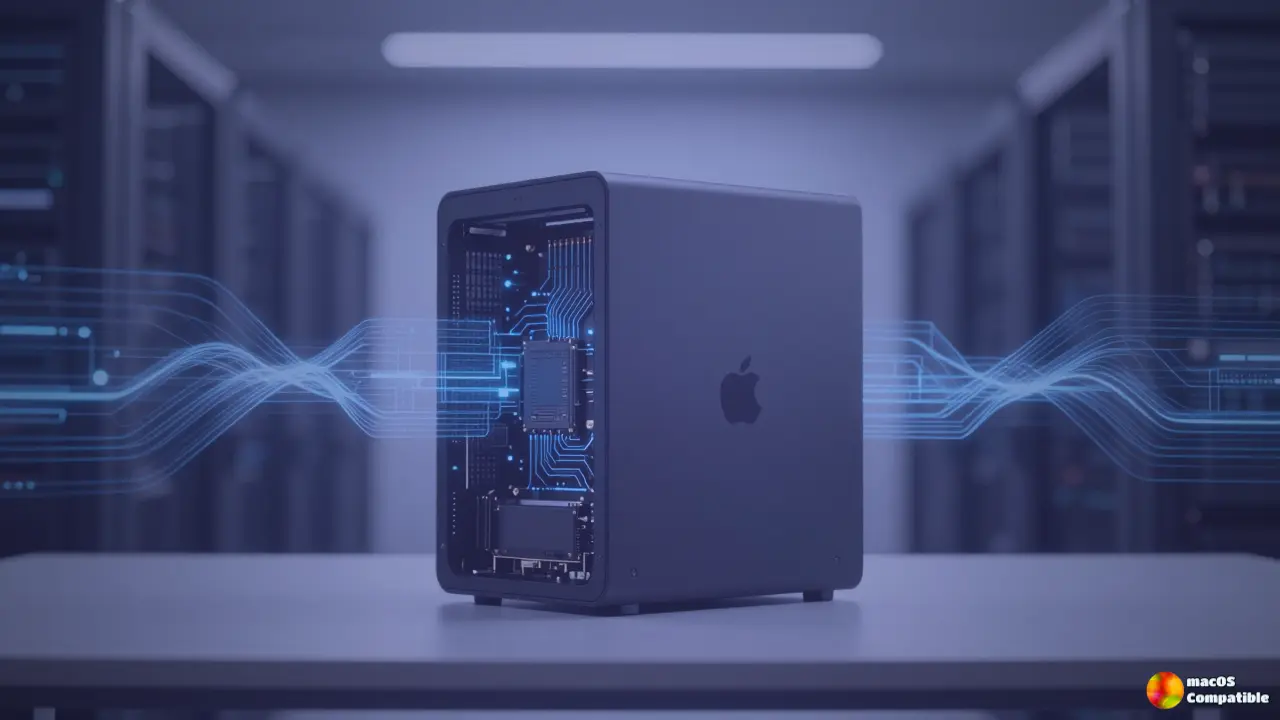
Server ambitions vs. reality
The 1.5TB memory ceiling isn't a laptop spec. This is a server play. Gurman reports the M7 Ultra will form the basis of a new Apple server product. You're looking at Apple Silicon going head-to-head with NVIDIA, AMD, and Intel in the data center.
Apple has no public track record operating merchant compute at data-center scale. Building a competitive server requires more than silicon. You need networking infrastructure, cooling systems, orchestration tools, and a software stack that hyperscalers have spent a decade refining. Gurman's report doesn't detail how Apple plans to package or sell this hardware. It's a significant risk.
The Neural Engine's hidden roots
The M7 Ultra's Neural Engine traces its lineage to Project Titan. Apple's abandoned self-driving car project required on-device AI processing. The car chip design was never finished, but the IP survived. Apple redirected that neural accelerator into consumer silicon.
The Neural Engine debuted in the A11 Bionic chip in 2017. It powered FaceID and Animoji on the iPhone X. It migrated to the M-series chips, giving Apple a privacy advantage by keeping inference on-device. The M7 Ultra represents the culmination of that effort. Apple is doubling down on silicon to compensate for a lagging AI software stack.
Pricing and the memory crunch
Mac Studio configurations have been bleeding high-end RAM options recently. Apple cut the 512GB and 256GB configurations of the M3 Ultra, leaving 96GB as the top option. The M7 Ultra could restore that high-end tier, but at a steep price.
Roughly $25 per gigabyte is a common metric for enterprise RAM upgrades. Moving from a base 128GB config to 1.5TB would cost over $35,000. That's not a consumer upgrade. That's an enterprise-grade offering. If you need that much memory, the M7 Ultra might be your only Apple option, assuming availability holds.
Apple's AI software has lagged behind competitors. Apple Intelligence landed unevenly. The company even sued OpenAI alleging trade secret theft. The M7 program signals Apple's answer to the software gap is to invest heavily in silicon. But hardware can't fix everything.


